Juniper JN0-481練習問題 & JN0-481無料試験
Wiki Article
無料でクラウドストレージから最新のMogiExam JN0-481 PDFダンプをダウンロードする:https://drive.google.com/open?id=1RGsmweTQZkVX5X1Y1rqKXxvTpJRtZF48
Juniper高効率のJN0-481学習教材を使用すれば、プロの認定試験に合格した製品を使用しなかった場合に必要な時間の半分を費やすだけで済みます。 このようにして、旅行、パーティー、さらに別の試験の準備をする時間が増えます。 あなたにとってJN0-481トレーニングトレント:MogiExamのData Center, Specialist (JNCIS-DC)の利点は、金銭による評価からはほど遠いものです。 一流の専門家チーム、Data Center, Specialist (JNCIS-DC)高度な学習コンセプト、完全な学習モデルがあります。 私たちの学習教材であなたのために節約された時間はJN0-481、私たちにとって最大のリターンです。
Juniper JN0-481 認定試験の出題範囲:
| トピック | 出題範囲 |
|---|---|
| トピック 1 |
|
| トピック 2 |
|
| トピック 3 |
|
| トピック 4 |
|
素晴らしいJN0-481練習問題一回合格-有難いJN0-481無料試験
専門的に言えば、試験を受けるに関するテクニックを勉強する必要があります。MogiExamというサイトは素晴らしいソースサイトで、JuniperのJN0-481の試験材料、研究材料、技術材料や詳しい解答に含まれています。問題集が提供したサイトは近年で急速に増加しています。あなたは試験の準備をするときに見当もつかないかもしれません。MogiExamのJuniperのJN0-481試験トレーニング資料は専門家と受験生の皆様に証明された有効なトレーニング資料で、あなたが試験の合格することを助けられます。
Juniper Data Center, Specialist (JNCIS-DC) 認定 JN0-481 試験問題 (Q66-Q71):
質問 # 66
You created a virtual network and allocated it to the incorrect routing zone.
In this scenario, what are two ways to assign the virtual network property? (Choose two.)
- A. Edit the connectivity template and replace the incorrect routing zone with the correct routing zone.
- B. Delete the virtual network and then re-create it by assigning the correct routing zone.
- C. Remove the tag from the incorrect routing zone and add the tag to the correct routing zone.
- D. Edit the virtual network and replace the incorrect routing zone with the correct routing zone.
正解:B、D
解説:
Delete the virtual network and then re-create it by assigning the correct routing zone - This is a valid method, especially if editing is restricted or not allowed after initial creation.
Edit the virtual network and replace the incorrect routing zone with the correct routing zone - If the UI allows, this is the more direct approach to fix the assignment without deleting the virtual network.
質問 # 67
What does clicking the indicated icon shown in the exhibit accomplish?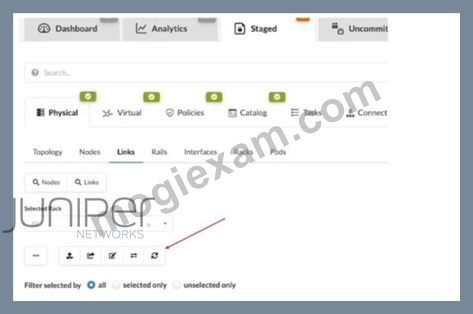
- A. It erases the entire cable map to start over.
- B. It refreshes the screen.
- C. It fetches the discovered Link Layer Discovery Protocol (LLDP) data.
- D. It changes the speed of existing links.
正解:C
解説:
In Apstra 5.1, the Staged > Physical > Links workspace is where you build and validate the cabling (link) intent for the fabric before committing changes. During deployment and day-0/1 build, Apstra can leverage LLDP neighbor discovery from the connected devices to accelerate and validate the cabling map. The indicated toolbar icon in the Links view is used to fetch discovered LLDP data from the devices so Apstra can compare the discovered neighbor relationships with the intended topology and, depending on workflow, help populate or validate link endpoints.
This is particularly important in leaf-spine IP fabrics because correct physical connectivity underpins the entire underlay-interface states, point-to-point addressing, and BGP sessions. In an EVPN-VXLAN design running Junos v24.4, broken or mis-cabled links quickly manifest as missing underlay adjacencies and failed EVPN control-plane signaling. Pulling LLDP discovery into Apstra helps you identify mismatches early (wrong neighbor, wrong port, missing neighbor) and reduces manual cabling errors.
This action is not merely a UI refresh, it does not wipe the cable map, and it does not modify link speeds. Its operational purpose is to import discovered LLDP neighbor information into the blueprint's physical link view so Apstra can assist with accurate topology validation and deployment readiness.
質問 # 68
In Juniper Apstra terminology, to which network operating system concept does a routing zone refer?
- A. VLAN
- B. Access list
- C. IRB
- D. VRF
正解:D
解説:
In Apstra 5.1, a routing zone is the primary construct used to represent an L3 domain for multitenant isolation. In traditional network operating system terms, that maps to a VRF (Virtual Routing and Forwarding instance). Each routing zone is placed "in its own VRF," which provides independent routing tables and isolates IP traffic so that different tenants can reuse overlapping IP subnets without conflict. This is central to modern EVPN-VXLAN data center design, where tenants typically require clean separation of routing and policy boundaries.
Within a routing zone, you can create one or more virtual networks (often mapped to VXLAN segments) that provide L2 extension across racks while still being contained by the tenant's VRF. If L3 gateway services are enabled for those virtual networks, their gateway interfaces (for example, IRB interfaces on Junos v24.4 leaf switches) are associated with the routing zone's VRF so that inter-subnet routing occurs within the tenant boundary.
This terminology distinction is important: an IRB is an interface construct used to provide L3 gateway functionality for a VLAN/VXLAN segment; a VLAN is a Layer 2 segmentation mechanism; and an access list is a policy enforcement tool. A routing zone, however, defines the tenant's L3 routing context, which is precisely what a VRF provides on Junos.
Verified Juniper sources (URLs):
https://www.juniper.net/documentation/us/en/software/apstra5.0/apstra-user-guide/topics/concept/routing-zones.html
https://www.juniper.net/documentation/us/en/software/apstra4.2/apstra-user-guide/topics/concept/routing-zones.html
質問 # 69
You are using Juniper Apstra to create security policies that create ACLs on the fabric devices. What are two valid objects that would be used within Apstra in this scenario? (Choose two.)
- A. Virtual network
- B. Routing zone
- C. Application signature
- D. Domain name
正解:A、B
解説:
In Apstra 5.1, Security Policies express traffic-permit/deny intent between defined fabric endpoints, and Apstra compiles that intent into ACL enforcement on the appropriate switches (for example, on gateway interfaces for east-west segmentation and on border leaf interfaces for north-south controls). The objects you use to define that policy intent must correspond to fabric connectivity constructs that Apstra understands as endpoints in the blueprint's logical model.
Two such valid objects are Virtual Networks and Routing Zones. A virtual network represents a tenant segment (typically mapped into EVPN-VXLAN constructs such as VNI and associated IRB gateway when L3 is enabled). Policies between virtual networks are a common way to implement micro-segmentation or tier-based segmentation (web/app/db) within the same tenant boundary. A routing zone represents the L3 tenancy boundary (mapped to a VRF) and can be used to group and control connectivity at the tenant level, especially where policy needs to be expressed for aggregated tenant domains or for controls involving external connectivity.
"Domain name" and "application signature" are not endpoint objects for Apstra Security Policies in this context. They may exist in other security ecosystems, but Apstra's security intent model for ACL generation is based on topology and blueprint objects (routing zones, virtual networks, and endpoint definitions), which can then be rendered into Junos v24.4 firewall filter-style enforcement on the fabric devices.
Verified Juniper sources (URLs):
https://www.juniper.net/documentation/us/en/software/apstra5.1/apstra-user-guide/topics/topic-map/policy-security.html
https://www.juniper.net/documentation/us/en/software/apstra5.1/apstra-user-guide/topics/concept/routing-zones.html
https://www.juniper.net/documentation/us/en/software/apstra5.1/apstra-user-guide/topics/concept/virtual-networks.html
質問 # 70
Referring to the exhibit, what happens when an operator clicks the Accept Changes button on the right side of the screen in Juniper Apstra?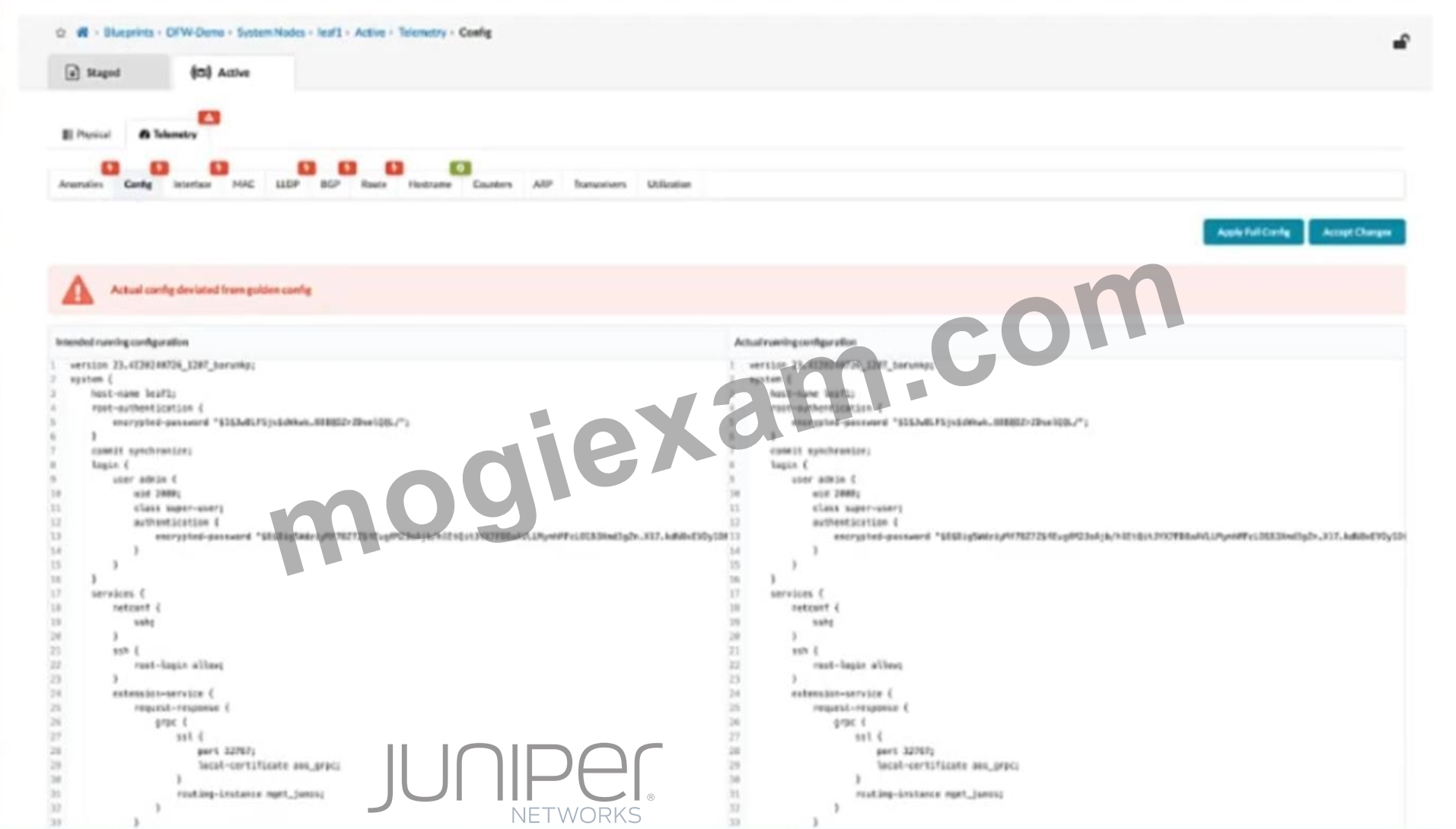
- A. Apstra will add a similar configuration from a known device context to accomplish the goal of the CLI-entered configuration.
- B. Apstra will incorporate the new CLI into the "golden config".
- C. Apstra will not commit new changes to this device until the user clicks the Apply Full Config button.
- D. Apstra will stop warning about the changes, but the changes will be overwritten at the next commit.
正解:B
解説:
In Juniper Apstra, the Accept Changes button is used when the running configuration on a device has been manually modified outside of Apstra's intent-based automation. Clicking Accept Changes reconciles these differences by updating Apstra's "golden config" to include the CLI- entered changes, ensuring that Apstra's intended state matches the actual device configuration.
This way, Apstra will stop flagging the deviation as a mismatch.
質問 # 71
......
MogiExam JuniperのJN0-481試験問題集は完全な無制限のダンプが含まれていますから、MogiExamを利用したら気楽に試験に受かることができます。製品検定合格の証明書あるいは他の人気がある身分検定によって、MogiExam JuniperのJN0-481試験トレーニング資料の長所を完璧に見せることができます。依頼だけでなく、指導のことも最高です。MogiExam JuniperのJN0-481試験トレーニング資料に含まれている問題と解答を利用して、JuniperのJN0-481認定試験に合格することができます。
JN0-481無料試験: https://www.mogiexam.com/JN0-481-exam.html
- JN0-481ブロンズ教材 ???? JN0-481最新受験攻略 ???? JN0-481受験資料更新版 ???? { www.copyright.jp }で➤ JN0-481 ⮘を検索し、無料でダウンロードしてくださいJN0-481日本語認定
- 100%合格率-有効的なJN0-481練習問題試験-試験の準備方法JN0-481無料試験 ???? ⏩ www.goshiken.com ⏪で➡ JN0-481 ️⬅️を検索して、無料で簡単にダウンロードできますJN0-481ブロンズ教材
- JN0-481日本語認定 ???? JN0-481試験情報 ???? JN0-481認証資格 ???? ➡ www.copyright.jp ️⬅️を入力して▶ JN0-481 ◀を検索し、無料でダウンロードしてくださいJN0-481模擬体験
- JN0-481模擬体験 ???? JN0-481 PDF問題サンプル ???? JN0-481最新受験攻略 ???? 「 JN0-481 」を無料でダウンロード⇛ www.goshiken.com ⇚で検索するだけJN0-481認証資格
- 100%合格率-有効的なJN0-481練習問題試験-試験の準備方法JN0-481無料試験 ???? ⇛ www.xhs1991.com ⇚を開いて➡ JN0-481 ️⬅️を検索し、試験資料を無料でダウンロードしてくださいJN0-481再テスト
- JN0-481日本語認定 ???? JN0-481サンプル問題集 ???? JN0-481サンプル問題集 ???? ➽ www.goshiken.com ????サイトにて最新⇛ JN0-481 ⇚問題集をダウンロードJN0-481対策学習
- 試験の準備方法-最高のJN0-481練習問題試験-一番優秀なJN0-481無料試験 ???? ⇛ www.mogiexam.com ⇚で▷ JN0-481 ◁を検索して、無料で簡単にダウンロードできますJN0-481入門知識
- JN0-481関連試験 ???? JN0-481資格試験 ???? JN0-481模擬資料 ???? ▷ www.goshiken.com ◁で⇛ JN0-481 ⇚を検索し、無料でダウンロードしてくださいJN0-481 PDF問題サンプル
- 実際的なJN0-481練習問題試験-試験の準備方法-一番優秀なJN0-481無料試験 ???? ➽ jp.fast2test.com ????に移動し、▷ JN0-481 ◁を検索して無料でダウンロードしてくださいJN0-481入門知識
- 素敵JN0-481|正確的なJN0-481練習問題試験|試験の準備方法Data Center, Specialist (JNCIS-DC)無料試験 ???? 今すぐ【 www.goshiken.com 】を開き、「 JN0-481 」を検索して無料でダウンロードしてくださいJN0-481 PDF問題サンプル
- JN0-481資格参考書 ???? JN0-481認証資格 ???? JN0-481試験感想 ???? ウェブサイト「 www.shikenpass.com 」を開き、⇛ JN0-481 ⇚を検索して無料でダウンロードしてくださいJN0-481関連試験
- zaynqlwb144808.tkzblog.com, www.stes.tyc.edu.tw, push2bookmark.com, regankela388932.topbloghub.com, imogensfri504266.wikifrontier.com, www.stes.tyc.edu.tw, tiannavsjr317533.izrablog.com, deborahbkwm268043.tdlwiki.com, www.stes.tyc.edu.tw, lancebsvt985852.p2blogs.com, Disposable vapes
P.S. MogiExamがGoogle Driveで共有している無料かつ新しいJN0-481ダンプ:https://drive.google.com/open?id=1RGsmweTQZkVX5X1Y1rqKXxvTpJRtZF48
Report this wiki page